THE SHORT ANSWER
The Global Circularity Protocol represents the most credible effort to establish a common business language for circularity. Its impact depends on whether businesses use it to foster new conversations rather than just to measure existing activities.
WHAT IS THE GLOBAL CIRCULARITY PROTOCOL?
Launched at COP30 in November 2025, the GCP is the first voluntary global framework for measuring, managing, and communicating circularity performance. Developed by over 150 experts from more than 80 organisations, it offers a standardised approach to assess material flows, including inputs, usage, and end-of-life outcomes. If widely adopted, it could save up to 120 billion tonnes of materials and avoid 76 gigatons of CO₂ by 2050.
Source: wbcsd.org
While the potential is significant, the risks are also considerable. Global circularity fell from 9.1% to 6.9% during the development of earlier frameworks. Improved measurement alone did not improve outcomes. The GCP’s value will similarly depend on how businesses implement it.
While the potential is significant, the risks are also considerable. Global circularity fell from 9.1% to 6.9% during the development of earlier frameworks. Improved measurement alone did not improve outcomes. The GCP’s value will similarly depend on how businesses implement it.
Source: Global Circularity Report 202
THE UK PICTURE — AND WHY IT MATTERS NOW
The GCP’s launch aligns with growing regulatory pressure in the UK. Since March 2025, Simpler Recycling regulations require all businesses with 10 or more employees to separate waste streams. Extended Producer Responsibility for packaging is changing cost structures. Scotland passed the Circular Economy (Scotland) Act in 2024, and the UK Circular Economy Strategy is expected this year. Businesses that use the GCP strategically, rather than just for compliance, will be better positioned.
WHAT IT MEANS IN PRACTICE
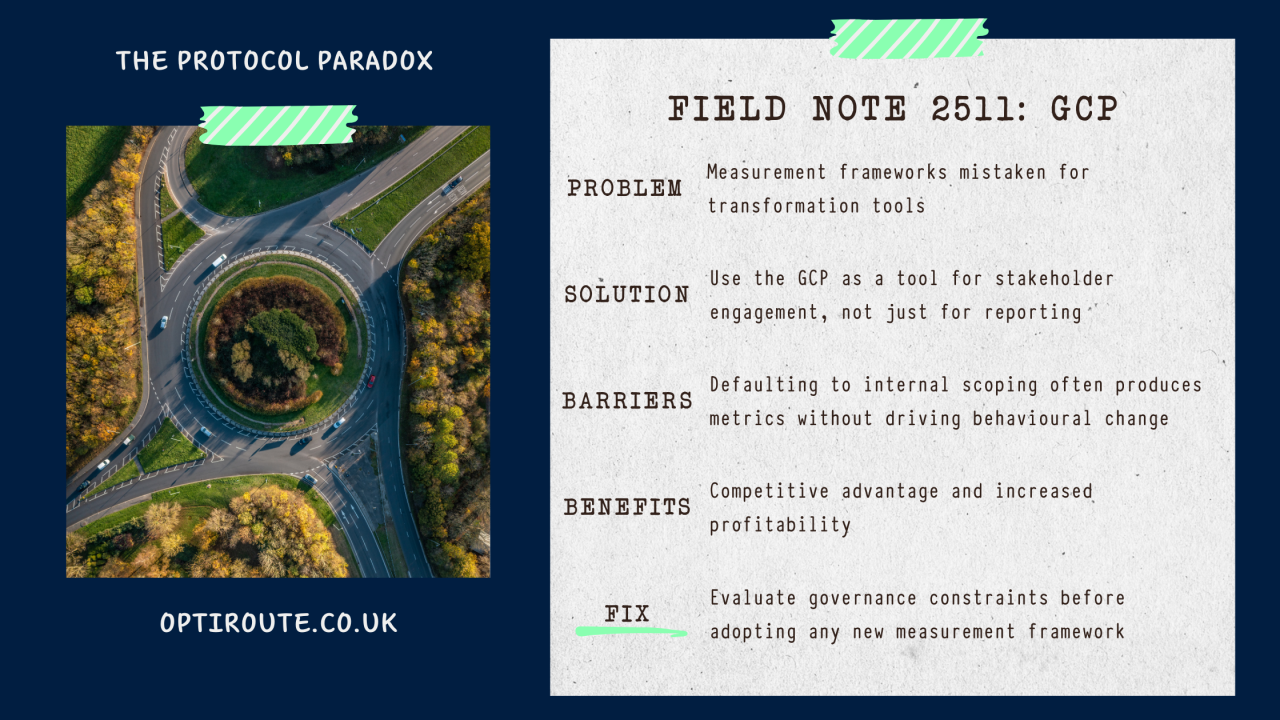
The standard GCP implementation sequence recommends defining scope internally before involving external stakeholders. While this produces consistent, auditable metrics, it often fails to drive behavioural change. Critical questions that enable systemic transformation are usually addressed only after scoping. For example: What do suppliers do with specific materials? Where does waste occur in the shared system? What collaboration is needed to recover value currently unrealised by either party? Interface, a global carpet tile manufacturer, achieved major circular innovation by reversing the typical sequence. Rather than first measuring material flows, Interface partnered directly with fishing communities and NGOs to recover discarded fishing nets for use as raw material. Here, the partnership defined the scope, and the solution emerged through collaboration. Metrics validated the partnership’s outcomes.
Source: interface.com
BARRIERS AND BENEFITS
This structural risk is not unique to the GCP; it exists in any framework. As measurement systems become more credible and complex, there is a tendency to mistake measurement completion for real progress. For SMEs, the resources needed for proper GCP implementation are significant, making it more likely that a finished assessment will be seen as actual advancement.
A Bain and WEF survey of 420 global manufacturing leaders found that 97% of businesses implementing circular solutions cited profitability and competitive advantage, not sustainability, as their main motivation. Over 70% expect circular solutions to increase revenue by 2027. The businesses that achieve these benefits are those that use circular thinking to create innovative supply chain relationships and commercial arrangements, not those with the most detailed circularity reports.
A Bain and WEF survey of 420 global manufacturing leaders found that 97% of businesses implementing circular solutions cited profitability and competitive advantage, not sustainability, as their main motivation. Over 70% expect circular solutions to increase revenue by 2027. The businesses that achieve these benefits are those that use circular thinking to create innovative supply chain relationships and commercial arrangements, not those with the most detailed circularity reports.
Source: Bain / WEF
WHERE TO BEGIN
Before adopting the GCP, organisations should assess the objectives of their current governance structures. Factors such as ownership, structure, culture, policies, and procedures may limit circular options. Identify procurement contracts that block take-back arrangements and incentives that favour volume purchasing over lifecycle considerations. While the GCP shows what is theoretically possible, governance determines what is practically achievable.
Start with a governance assessment. Then use the GCP to engage two or three key suppliers and one key customer in co-defining the circularity scope. Their insights on value loss can reveal opportunities that internal scoping may miss and help build commercial relationships that are difficult for competitors to replicate.
Start with a governance assessment. Then use the GCP to engage two or three key suppliers and one key customer in co-defining the circularity scope. Their insights on value loss can reveal opportunities that internal scoping may miss and help build commercial relationships that are difficult for competitors to replicate.
GO DEEPER
Global Circularity Protocol — globalcircularityprotocol.org
Scotland’s Circular Economy Act 2024 — useful reference for where UK regulation is heading. legislation.gov.uk
Optiroute — To employ the GCP as a genuine transformation tool, not just for reporting, organisations must prioritise governance discussions. optiroute.co.uk