
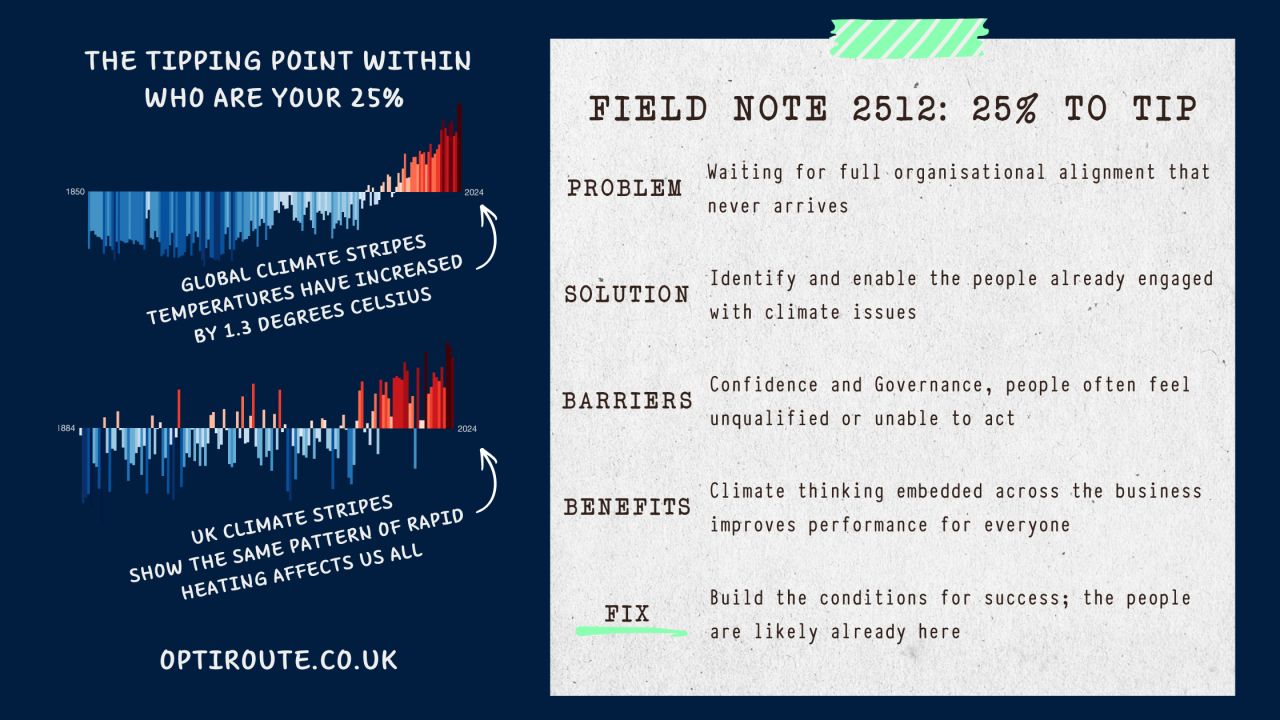
THE SHORT ANSWER
It is not necessary to achieve unanimous support before initiating climate action within your business. Research on social tipping points indicates that when approximately 25% of a group adopts a new norm, the rest often follow suit. For example, in a business of 40 people, this equates to ten individuals; in a business of 100, it is 25. Most organisations already have this engaged minority. The critical issue is whether governance enables these individuals to act or inadvertently restricts their efforts.
WHAT IS THE 25% TIPPING POINT?
Research led by Damon Centola at the University of Pennsylvania demonstrates that committed minorities, rather than majorities, drive changes in group norms. The primary mechanism is social proof: once a sufficient number of individuals visibly adopt a new behaviour, it becomes normalised. In the context of climate action within businesses, the objective is not consensus but rather identifying already engaged individuals and creating structures that enable them to act. The research suggests that this threshold is approximately 25% of any group.
Source: Penn Today
"Never doubt that a small group of thoughtful, committed citizens can change the world. Indeed, it's the only thing that ever has”
Margaret Mead - American cultural anthropologist, author and speaker.
THE UK PICTURE — AND WHY IT MATTERS NOW
The climate stripes, which visualise global temperature anomaly data, have shifted from blue to deep red within a single working lifetime. The opportunity for a managed and voluntary transition is diminishing. UK businesses are facing an increasingly stringent regulatory environment: mandatory climate risk reporting is expanding throughout supply chains, net zero commitments are evolving into procurement requirements rather than marketing statements, and organisations that have already developed internal climate capabilities will experience lower costs and less disruption than those that respond only under regulatory pressure.
WHAT IT MEANS IN PRACTICE
In Carrickfergus, Northern Ireland, Lee Robb of Positive Carrickfergus led a consultation with local residents to identify effective community interventions. A key recommendation was to establish a community-owned greengrocer. A working group of nine formed, registered as a community benefit society, and raised over £34,000 through a community share offer. Carrick Greengrocers opened in July 2023 with 434 members. Although the initial business plan projected £625 in first-week revenue, the shop achieved £10,000. This initiative reintroduced fresh, locally grown produce to a high street that had lacked a greengrocer for years, created new opportunities for local farmers, and began reinvesting in the local food system. Evidence from the Friendly Food Club, a pilot program offering climate-friendly produce at subsidised prices, is now shaping food policy proposals in Northern Ireland and the United Kingdom.
Source: carrickgreengrocers.org
BARRIERS AND BENEFITS
The primary barrier is not a lack of knowledge, budget, or leadership commitment; it is confidence. Individuals concerned about climate issues often feel unqualified to act, fear making incorrect decisions, or worry about exceeding their defined roles. A secondary barrier lies in governance: if organisational culture discourages experimentation or confines sustainability to a specialist function, the engaged 25% cannot realise their potential, as indicated by the research.
When climate considerations are integrated throughout an organisation, rather than isolated within a dedicated sustainability team, overall performance improves. Finance teams that monitor carbon emissions alongside costs identify previously unnoticed inefficiencies. Procurement departments that implement lifecycle thinking enhance supply chain resilience. Human resources teams that incorporate environmental values into hiring processes attract candidates that competitors may overlook. In this way, climate action transitions from a reporting obligation to a strategic perspective that enhances core business functions.
WHERE TO BEGIN
Begin by identifying the 25% within your organisation who are already engaged with climate issues, even if their involvement is not highly visible. Determine what these individuals require to be effective; this may not involve a formal programme, but rather permission, time, and a clear alignment with the organisation’s direction. This is fundamentally a question of culture and structure, rather than strategy. If sustainability is added to existing workloads without granting real authority to influence practices, the engaged 25% are likely to experience burnout instead of driving normative change. The key governance consideration is whether your organisation is structured to support their success.
GO DEEPER
Damon Centola, How Behavior Spreads (2018) — the academic foundation for the 25% tipping point.
Climate Stripes — global temperature visualisation. showyourstripes.info
Optiroute — if the culture and structure of your business are quietly preventing your 25% from acting, that is a governance conversation. optiroute.co.uk