THE SHORT ANSWER
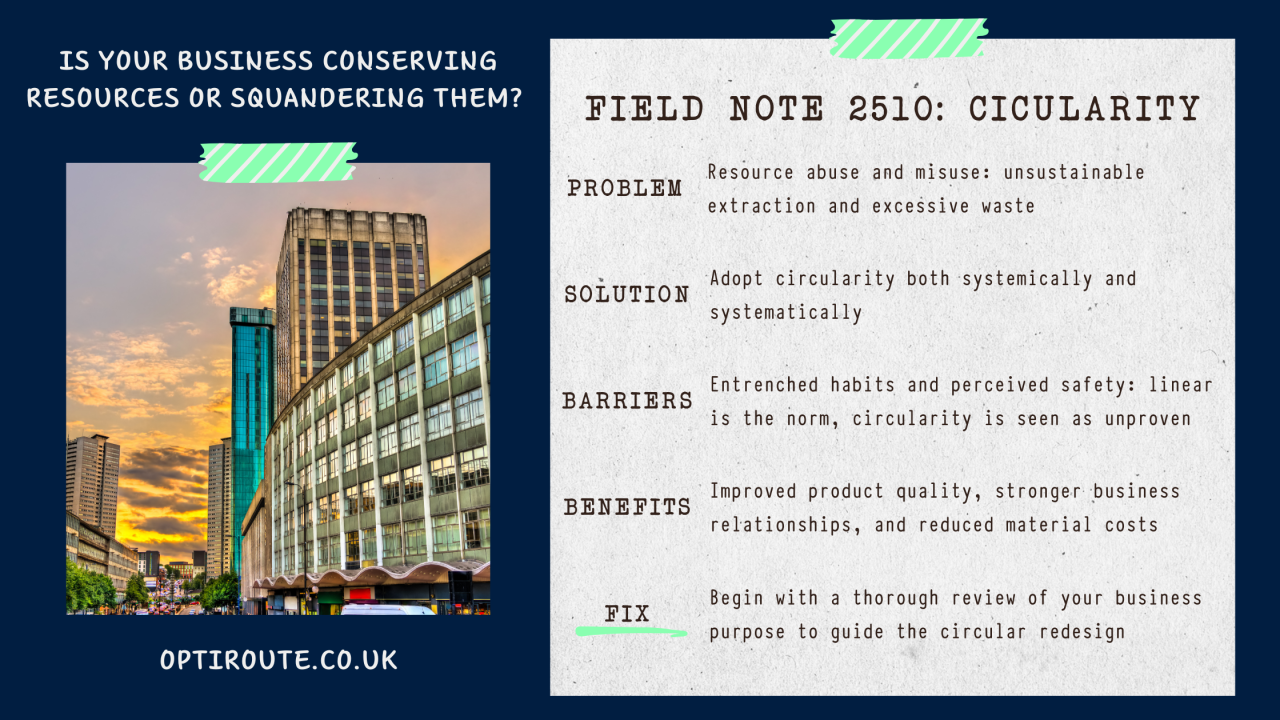
Conservers view resources as assets, extracting them responsibly, maximising their use, and designing for value recovery during and at the end-of-life. Squanderers, by contrast, operate linear systems that prioritise profit and disregard residual impacts. Most businesses fall between these approaches. Bridging this gap presents both a business opportunity and an environmental imperative.
CIRCULAR VS LINEAR
A linear economy takes virgin materials to produce goods and then disposes of them, assuming resources are unlimited and waste is not its responsibility. In contrast, a circular economy maintains materials at their highest value for as long as possible through design for longevity, repair, reuse, remanufacturing, and recovery. The Ellen MacArthur Foundation’s framework—eliminate waste and pollution, circulate products and materials, and regenerate natural systems—is widely adopted. Circularity extends beyond recycling; most recycling is downcycling, which recovers only part of a material’s value. True circularity starts with design.
THE UK PICTURE
Only 7.5% of materials in the UK economy are reused. Over 90% of the materials consumed by UK businesses are from virgin sources, with 80% of those extracted abroad. The UK’s material consumption is nearly twice the sustainable level. A 2024 survey of 300 UK supply chain decision-makers found that only 25% of businesses have adopted a circular economy model, while 22% have no plans to do so. Closing this gap could reduce the UK’s material footprint by 40% and carbon footprint by 43%, add £75 billion to the economy, and create 500,000 jobs by 2030.
WHAT CIRCULARITY MEANS IN BUSINESS
BMW’s iVision Circular concept car, introduced in 2021 for a 2040 production target, prominently highlights its circular features. The car is made entirely from recycled and fully recyclable materials, uses quick-release fasteners for disassembly, and omits paint to simplify end-of-life recovery. BMW has addressed circularity at the material and product levels, but not at the business model level. Achieving true circularity for a technical product like this requires a service-based model that prioritizes longevity, resource conservation, and material recovery throughout the vehicle’s use and at end-of-life. As it stands, this approach is only partially circular.
In contrast, Riversimple’s Rasa hydrogen car is designed with sustainable, recoverable materials and lightweight components for maximum efficiency, supported by a circular business model. Rather than selling cars, Riversimple will offer a monthly fee that covers the vehicle, fuel, insurance, and maintenance. The company retains ownership throughout the vehicle’s life, ensuring it is designed from the outset for circularity, resource conservation and value recovery. Both Riversimple and its value chain (suppliers and customers) benefit financially as vehicles last longer and materials are cycled more efficiently. This represents genuine, comprehensive circularity.
Source: riversimple.com
BARRIERS AND BENEFITS
The main barriers are entrenched habits and perceived safety. Linear supply chains, contracts, pricing, and KPIs are standard, and changing them is seen as risky. Circularity requires simultaneous changes to procurement, product design, supplier relationships, and sales models. Only 25% of UK businesses have adopted a circular economy model, while 22% have no plans to do so. However, businesses that have transitioned report higher revenue (56%), more efficient material use (56%), reduced carbon footprint (52%), and lower costs (49%). The commercial and resource cases are aligned.
Source: Ivalua, 2024.
WHERE TO BEGIN
Limiting circularity to waste reduction or material substitution results in only incremental improvements within a linear framework, not systemic change. Genuine circularity starts with governance: the organisation’s purpose and ownership structure must prioritise resource conservation. These foundational considerations should come before any product or operational redesign. Effective circular solutions often require collaboration across multiple businesses. Engaging key suppliers and customers to discuss material flows, take-back opportunities, and shared value in recovered resources offers a strategic starting point and builds relationships uncommon among competitors.
GO DEEPER
Ellen MacArthur Foundation — foundational frameworks for circular business model design. ellenmacarthurfoundation.org
Optiroute — governance-first sustainability consultancy supporting UK SMEs through circular thinking, governance design, and business model redesign. optiroute.co.uk
Optiroute — governance-first sustainability consultancy supporting UK SMEs through circular thinking, governance design, and business model redesign. optiroute.co.uk