
THE SHORT ANSWER
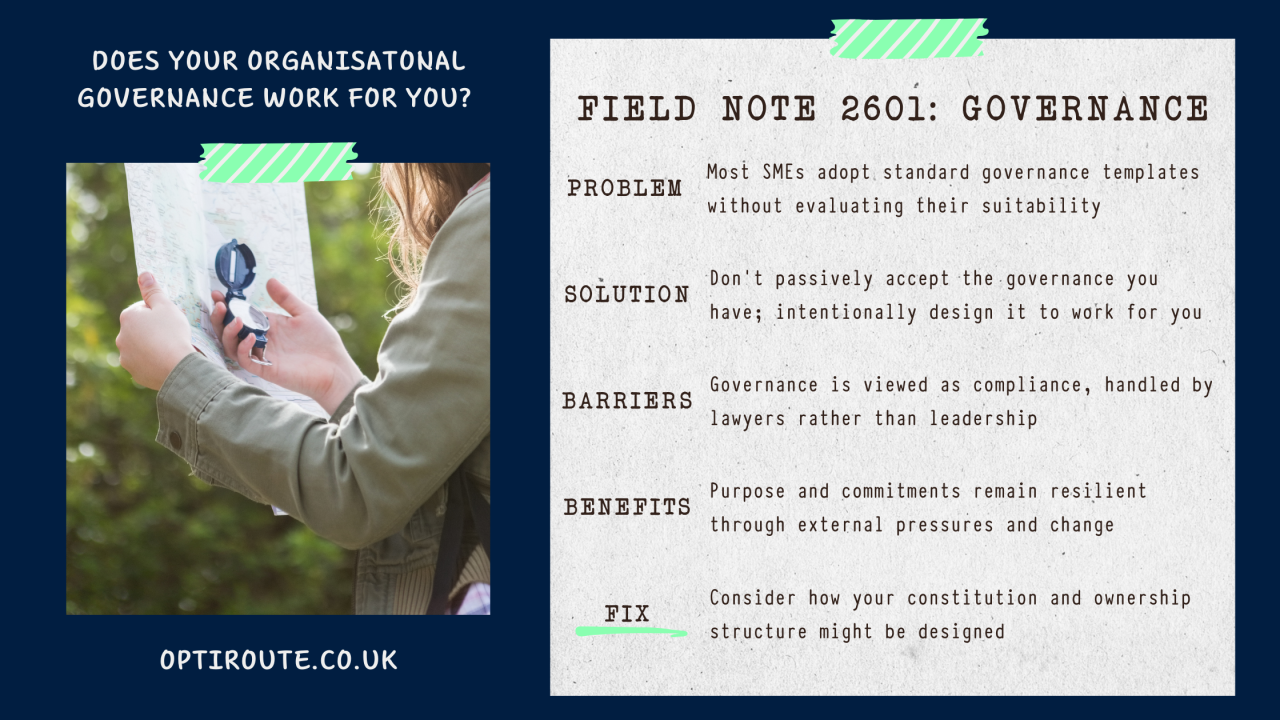
Every organisation has governance structures. The key question is whether yours was intentionally designed for current and future needs, or if it relies on inherited templates and outdated decisions. Governance acts as the organisational map, while strategy is the compass. Most businesses have a strategic direction, but fewer have a meaningful governance framework, and even fewer ensure alignment between the two.
WHAT IS GOVERNANCE — AND WHAT IT IS NOT
Governance goes beyond compliance. While compliance is binary, with requirements either met or unmet, governance includes decision-making, power distribution, commitment protection, and pursuit of organisational purpose. All organisations have these elements, but the main issue is whether they were intentionally designed or passively accumulated.
At Optiroute, we work with six governance elements:
- Purpose (why the organisation exists and the values that determine how it operates);
- Constitution (the foundational rules that define who holds power and how it can be exercised or changed);
- Ownership (who holds the business, and what behaviour that incentivises);
- Structure (reporting lines, decision authority, and information flows);
- Culture (how work actually gets done, regardless of what is documented); and
- Policies and Procedures (the practical translation of values into daily operations).
When these six elements are aligned, the organisation can achieve its objectives. Misalignment can cause even strong strategies to fail, not from lack of effort, but because the structure encourages outcomes that conflict with its purpose.
THE MAP AND THE COMPASS
A map without a compass gives context but no direction; a compass without a map gives direction but no context. Most businesses have strategies, but fewer have intentionally designed governance structures, and even fewer have checked if their governance aligns with current objectives.
Many assume governance is static, set at founding and revisited only for regulations or crises. As circumstances change, including environmental, supply chain, and stakeholder shifts, governance must adapt. Using outdated governance is like navigating with an old map. Reviewing governance shows commitment to purpose, not failure.
WHAT IT MEANS IN PRACTICE
Library of Things — a London-based lending platform that enables communities to borrow rather than buy — rewrote its governance from the ground up after its founders concluded that UK company law, as default, points organisations toward shareholder value rather than mission. Their articles of association now legally require directors and shareholders to put the mission first. Investors hold non-voting shares and sign an agreement committing to that priority before they invest. A separate guardian shareholder — a non-profit company whose members represent borrowers, local partners, investors, and the natural environment — holds the power to veto any exit or major asset sale that would compromise the mission.
The reasoning was clear. Co-founder Emma Shaw describes it as addressing both the consumption problem and the flawed capital system. Governance was not an add-on, but the business model made legally durable. As a result, the mission does not depend on current leadership, is not weakened by funding pressures, and does not rely on advocacy to survive. It is built into the structure.
Source: libraryofthings.co.uk
BARRIERS AND BENEFITS
The main barrier is the belief that governance belongs only to legal and compliance professionals, not to founders and leaders. Another barrier is the idea that pursuing purpose always brings financial costs. This misconception has led to both asset-stripping businesses and under-resourced social enterprises, both resulting from governance that fails to integrate financial and purpose-driven goals.
When governance is intentionally designed, organisational commitments withstand pressures from budget cycles, leadership changes, and investor negotiations. Purpose is embedded in the structure, not dependent on individual advocacy. Sustainability becomes part of operations, keeping the organisational map relevant.
WHERE TO BEGIN
Review your Articles of Association and shareholder agreements as design frameworks. For each element, ask the following questions:
- Does your Purpose reflect what you actually exist to create?
- Does your Constitution protect the commitments you want to make permanent?
- Does your Ownership structure reward the outcomes you say you care about?
Next, identify the gap between your current governance and the organisation your strategy envisions. If your strategy focuses on long-term goals but incentives drive short-term results, or if your purpose prioritises stakeholders but your structure reports only to shareholders, this gap is both the main issue and the starting point for redesign.
GO DEEPER
PAS 808:2022, Purpose-Driven Organisations for Delivering Sustainability — the BSI standard providing a framework for embedding purpose into governance, and the foundation for the forthcoming ISO 37011. bsigroup.com
Doughnut Economics Action Lab — tools for redesigning business models around stakeholder value. doughnuteconomics.org
Optiroute — governance-first sustainability consultancy for UK SMEs. optiroute.co.uk