
THE SHORT ANSWER
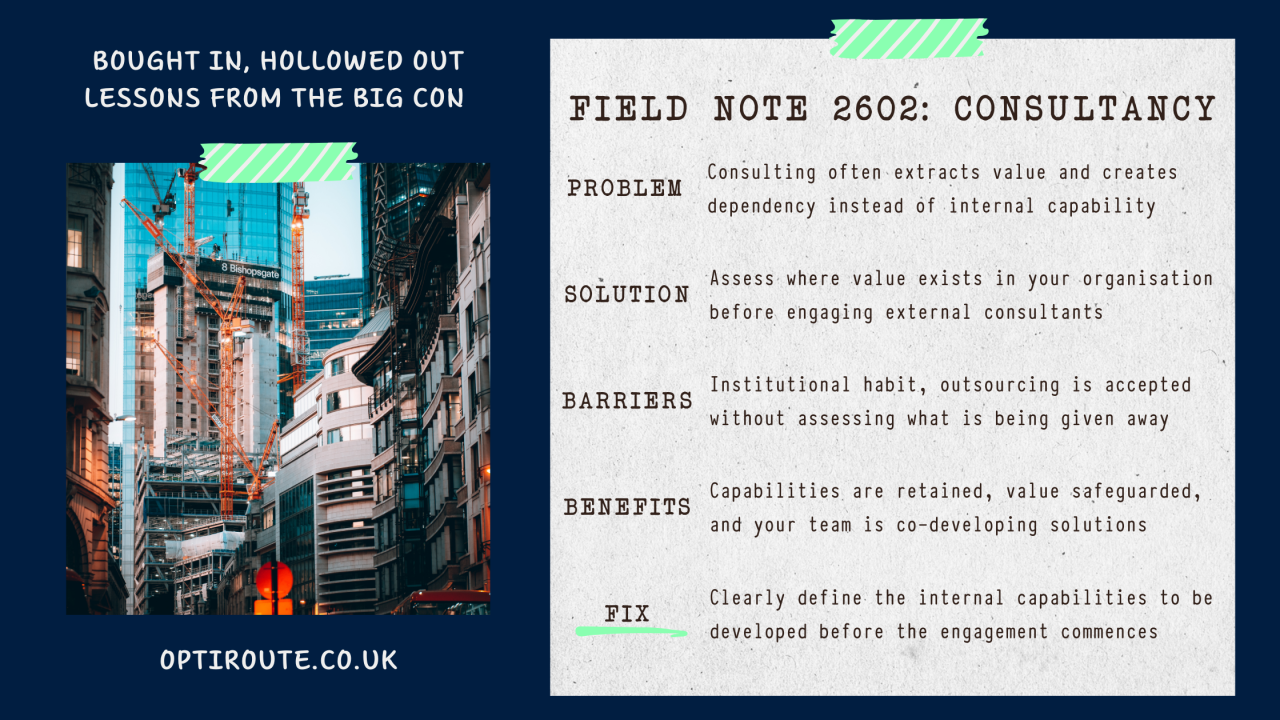
Consulting has become an effective means of extracting value in modern business. This is not a criticism of individual consultants, who often provide valuable expertise, but a structural observation: most consulting models reward time spent and increased complexity, rather than the development of internal capability. The key governance question is not whether to use external expertise, but whether your organisation understands where its value lies and whether consultant engagement protects or transfers that value.
THE EXTRACTION PROBLEM
In The Big Con, Mariana Mazzucato and Rosie Collington show how management consulting has become a multi-billion-pound industry that extracts value from organisations while avoiding accountability for outcomes. Consultant success is measured by billable hours, repeat engagements, and complex deliverables, while client success is measured by tangible transformation. These metrics are fundamentally in conflict. Building genuine internal capability reduces future consultant revenue, creating incentives for dependency. Proprietary frameworks, specialised reporting, and ongoing retainers often increase clients’ reliance on consulting services rather than serving long-term interests.
Across government and corporate sectors, organisations have spent decades outsourcing critical functions, eroding internal expertise, and becoming dependent on external firms for roles once managed internally. This trend has contributed to a broader decline in societal capability.
THE UK PICTURE AND ITS CURRENT RELEVANCE
The UK environment and sustainability consulting market reached £2.9 billion in 2022 and is projected to reach £4.9 billion by 2027. Growing pressure on businesses to demonstrate ESG credentials, achieve net-zero commitments, and comply with evolving regulations has created ideal conditions for the consulting extraction model. Complex requirements, limited leadership capacity, and the perceived security of established external firms reinforce this trend. For example, McKinsey’s advisory role in Australia, providing guidance on net-zero transition costs while also contracted to 43 of the country’s largest polluters, shows how misaligned incentives can result in analysis that prioritises the consultant’s interests over the client’s. A reputable name does not guarantee aligned outcomes.
Sources: Environment Analyst and The Guardian
WHAT IT MEANS IN PRACTICE
Optiroute was established to address this issue. Its model is built on one principle: each engagement should enhance the client’s internal capability. This involves working with client teams, setting up governance to protect commitments, and defining the capabilities to be developed by the end of the engagement. For clients who adopt this model, Optiroute shares outcome risk through the Opti-Alliance model, allocating 20% of fees to a shared success fund, returned when milestones are met. While not all clients start with this arrangement, every engagement ensures expertise remains within the client organisation.
Source: optiroute.co.uk
BARRIERS AND BENEFITS
The main barrier is institutional habit, where outsourcing is accepted without evaluating the transfer of value. Another barrier is the governance gap: most organisations have not identified where value resides, whether in employee expertise, supplier relationships, or market knowledge. Without this understanding, protecting organisational value is not possible.
When organisations prioritise building capability and engage consultants to develop, rather than simply perform, critical functions, the benefits increase. Solutions are tailored to the organisation’s context, not imposed externally. Ownership remains with those directly involved, deepening internal expertise. As a result, the organisation is better prepared for future challenges, with key capabilities retained internally.
WHERE TO BEGIN
Before engaging external support, organisations should conduct an internal governance assessment. Identify where value resides, whether in employee knowledge, processes, or key relationships, and consider potential losses from outsourcing. For each engagement, define the internal capabilities to be developed by the end of the contract. Set this exit condition at the outset. If a consultant cannot clearly explain which capabilities will remain with your organisation, this should influence your decision. Likewise, a fee structure that shows commitment to reducing client dependency is an important factor.
GO DEEPER
Mazzucato & Collington, The Big Con (2023) — the foundational case against the consulting industry’s extraction model.
Optiroute — governance-first sustainability consultancy designed to build capability, not dependency: optiroute.co.uk
Institute of Consulting — UK professional standards for consulting practice: iconsulting.org.uk