
THE SHORT ANSWER
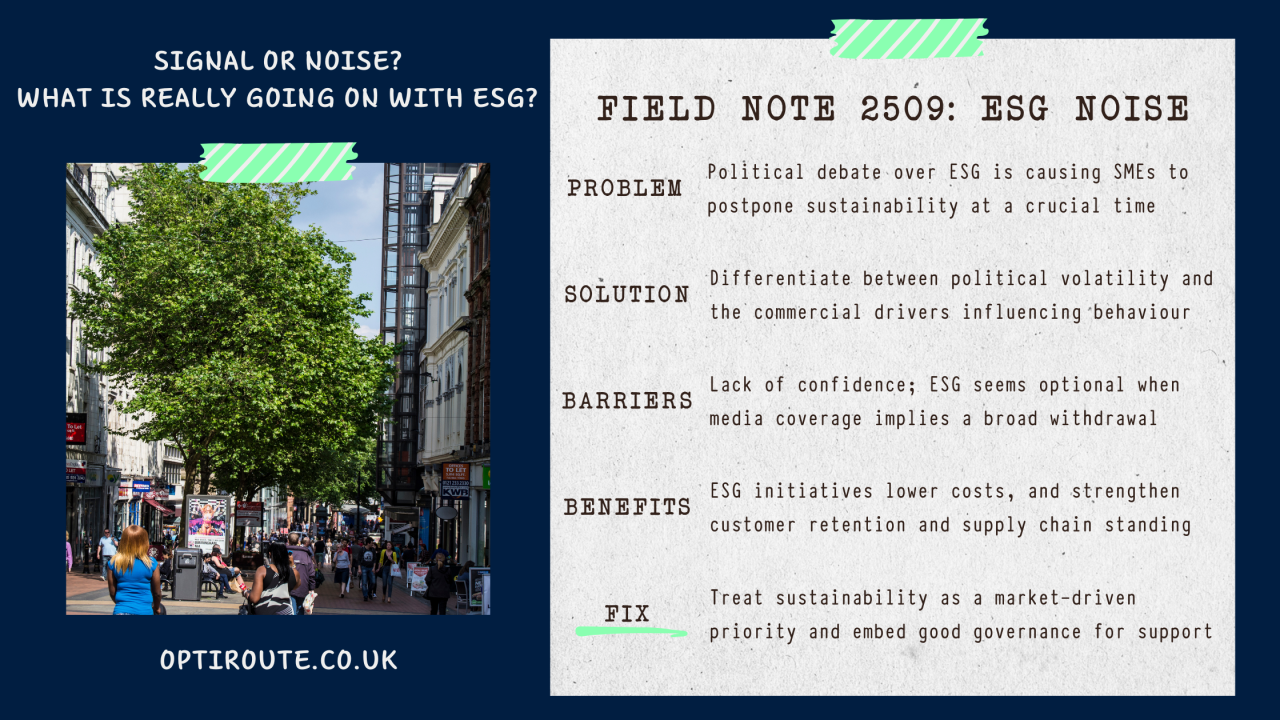
Political debate over ESG has increased. Some large businesses are scaling back public commitments, and changes in US climate policy have created uncertainty in Europe. For UK SMEs, delaying sustainability efforts may seem sensible, but research shows this is a strategic error. Commercial indicators point to a different path for SME competitiveness.
WHAT THE DATA ACTUALLY SHOWS
The belief in widespread corporate withdrawal from sustainability is largely shaped by media coverage. Harvard University research on 75 global companies found that only 13% have reduced their sustainability commitments. Most, 53%, are maintaining efforts, and 32% are expanding them, often without publicity. Only 8% have reversed commitments, and 5% have changed public messaging while continuing their programs. The most vocal companies are a minority; most organisations continue their sustainability initiatives.
This trend continues in the UK. A University of Nottingham and Browne Jacobson study found that over 80% of UK organisations remain committed to ESG and sustainability, regardless of political conditions. The British Business Bank’s 2025 net zero report confirms that SMEs taking climate action gain competitive advantages as larger firms increase Scope 3 supply chain requirements.
Sources: Hawkins and Cooper, Harvard Business Review (September 2025); University of Nottingham / Browne Jacobson (2025); British Business Bank (October 2025)
THE UK PICTURE AND WHY IT MATTERS NOW
UK SMEs account for about half of the country’s business-related greenhouse gas emissions and face increasing pressure from multiple directions. The SME Climate Hub’s 2025 survey of 471 businesses in 53 countries found that 61% are taking climate action due to customer expectations, up 21 percentage points from 2024. The share motivated by attracting new customers rose from 34% to 51%. These actions are driven by buyer requirements, not ideology. Supply chain pressure is now one of the fastest-growing factors; what was voluntary two years ago is now often required to win and keep contracts.
WHAT IT MEANS IN PRACTICE
Hoe Grange Holidays is a family-run glamping and log cabin business in the Peak District, founded by David and Felicity Brown in 2006 to diversify their farm. The entire site now operates on renewable energy, including wind turbines, solar panels, heat pumps, and infrared heating, reducing its carbon footprint by 77% and lowering operating costs. Instead of treating these savings as profit, the Browns reinvested in battery storage and smart EV charging, moving closer to their Net Zero 2030 goal. In March 2025, they were joint winners of the inaugural Green Growth Award, organised by Small Business Britain and BT to recognise UK SMEs leading in sustainable growth. Caroline Brown noted that guests value the business’s sustainability, but recognition from the wider business community was most rewarding for the team.
The story is not a story of ideology overcoming obstacles. Instead, operational improvements led to efficiency savings, which funded further investment, reduced costs, and strengthened the business’s appeal to customers who increasingly value sustainability.
Source: hoegrangeholidays.co.uk
BARRIERS AND BENEFITS
The main barrier is a lack of confidence. When prominent businesses publicly retreat from sustainability commitments, it can encourage others to do the same. Another barrier is confusing the ESG investment market, which faces political pressure and some capital outflows, with real-economy signals like customer demand and supply chain requirements. These are separate issues: the investment market is shaped by political cycles, while buyer priorities remain steady.
When SMEs view sustainability as a market issue, the benefits multiply. Energy efficiency lowers operating costs. Low-carbon credentials open supply chain opportunities competitors may miss. Documented commitments attract both talent and customers. Governance that embeds sustainability in procurement, energy management, and reporting increases resilience to future disruptions.
WHERE TO BEGIN
Separate meaningful market signals from background noise. Identify customers or prospects with net zero commitments that require supplier evidence. Review current or target contracts, especially in the public sector, for sustainability criteria. The gap between these requirements and your current position is a market risk, not just a compliance or political issue. Find which operations create the most avoidable costs, often linked to the highest emissions. Address these areas with decisive action, not lengthy strategy documents.
GO DEEPER
Optiroute — governance-first sustainability for UK SMEs. optiroute.co.uk